
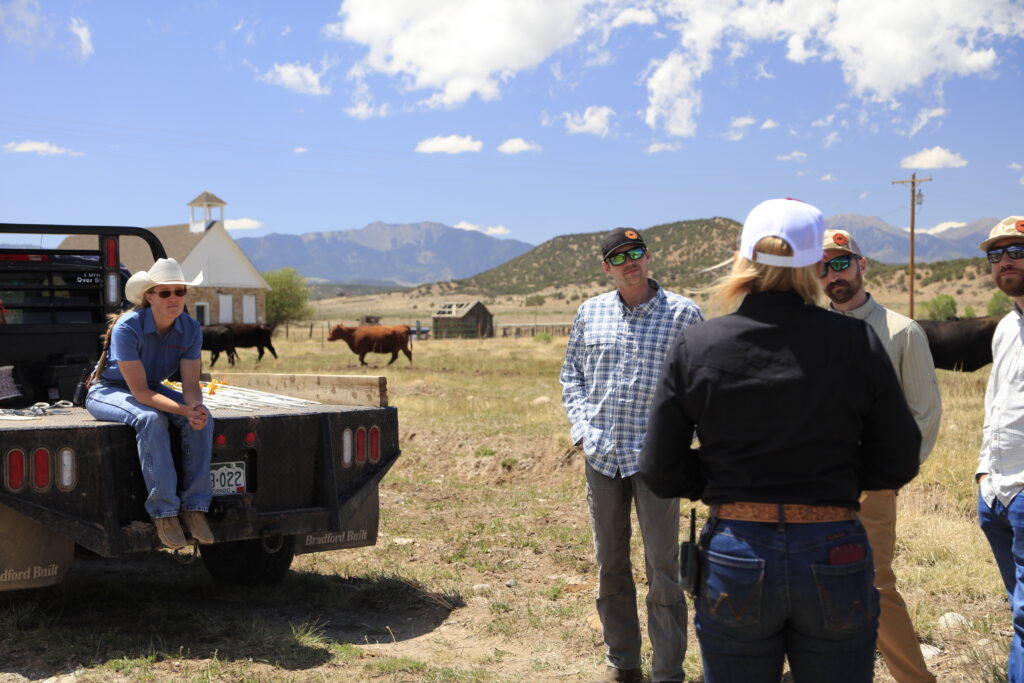
Last week, the Confluence Land Company team traveled to Redwing Ranch in Southern Colorado to participate in a workshop on regenerative grazing practices. Once treated as a fringe approach, regenerative grazing has moved into the mainstream of the production ranch conversation, with operators across the West rethinking stocking rates, pasture rotations, and soil health as levers for both profitability and long-term land value. Beef buyers, conservation groups, and lenders are paying increasing attention, and practices that started on a handful of ranches are now reshaping how working rangeland is managed, valued, and transacted. Below are our field notes from the day, drawing on the classroom session, a pasture assessment, and conversations with owner-operator Christy Wyckoff and her team about how adaptive grazing management is moving the needle on what working rangeland can produce.
Redwing Ranch and Christy Wyckoff
Redwing Ranch is a woman-owned and operated cattle ranch on the eastern slopes of the Sangre de Cristo Mountains in Southern Colorado. Christy pairs her extensive academic background with years of hands-on land management. Her career spans wildlife research, conservation leadership, and land stewardship. At the Santa Lucia Conservancy in California, she directed wildlife programs and managed conservation grazing operations before coming to Colorado to operate Redwing Ranch. Her academic training includes a PhD focused on wildlife disease ecology and degrees in biology and conservation science. Christy and her team’s focus has been to move Redwing from a conventional grazing program towards regenerative practices grounded in both ecology and livestock economics. With Redwing Ranch as their proving grounds, their team’s work leads the way for how ranchers can maximize rangeland health, carrying capacity, and the long-term sustainability in a way that not only benefits the land, but also producers’ balance sheet.
Continuing Education and Team Development
We completed this continuing education workshop as part of our commitment to deepening expertise across the Confluence Land Company team. Seminars like this sharpen our ability to advise clients on land stewardship, evaluate a property’s potential, and communicate the management considerations impacting transaction outcomes and land values. Time on working ranches with the people making these calls keeps our brokerage practice apprised of the real ecology and real economics on the ground. We’re grateful to Christy Wyckoff, ranch manager Fiona Jackson, programs manager Erin Sheridan, and the rest of the Redwing Ranch crew for generously hosting us and sharing their hard-earned knowledge and operational expertise.
Highlights of the Day
Classroom Sessions
The morning began with foundational work on grazing ecology and forage estimation using The US Department of Agriculture’s Range Analysis Platform (RAP). We covered how to use RAP, walked through its analysis tools, and built an understanding of adaptive multi-paddock grazing systems. Redwing’s ranch manager, Fiona Jackson, discussed soil health, water cycles, and carbon sequestration as outcomes of better grazing management. A key takeaway for our team was how RAP layers onto the GIS and property mapping tools we already use in our brokerage practice. By overlaying RAP’s forage productivity estimates on pasture boundaries alongside water infrastructure and terrain data, a property map becomes a great starting point to understand how management changes or infrastructure improvements can benefit a ranch. Those same tools have direct implications for livestock nutrition, knowing not just how much forage a pasture produces but when it peaks and what plant communities drive that productivity helps operators time rotations to capture forage at its highest nutritional value, balance protein and energy across the grazing season, and identify pastures where targeted mineral supplementation may benefit utilization.
Ground-truthing and Pasture Walk
In the afternoon, we moved across Redwing Ranch to see this theory in action. We compared two pastures in markedly different conditions, examining what adaptive multi-paddock grazing looks like when executed well. We ground-truthed RAP data against visual assessment, understood carrying capacity from both numbers and boots on the ground, and discussed water infrastructure, terrain impacts, and how management decisions determine both immediate grazing outcomes and long-term rangeland health.
Understanding RAP
The Range Analysis Platform translates satellite imagery and weather data into forage productivity estimates for specific properties. For brokers, this moves assessment beyond “the land looks good” or seller-reported productivity into more concrete numbers: an estimate of how much forage a property historically produce in an average year, a dry year, a wet year? RAP data, confirmed against what you see on the land, helps answer whether apparent forage shortages reflect poor management or genuinely limited capacity due to soil types, terrain, and plant communities. However, this tool has limitation, it loosely accounts for water distribution, terrain accessibility, and recent management changes won’t be reflected, but used honestly as a preliminary or comparative tool, it’s a useful lens for evaluating what a property can realistically support.
Adaptive Multi-Paddock Grazing: How It Works
Adaptive multi-paddock (AMP) grazing inverts the conventional approach. Instead of leaving cattle in large pastures for months, AMP involves frequent moves, typically every few days, to smaller areas, with cattle density and timing adjusted based on forage conditions, animals’ nutritional needs, and seasonal rainfall or snowpack. The system requires infrastructure: at Redwing, that means over 30 pastures, strategic water sources to ensure uniform grazing, and careful placement of mineral supplements to encourage cattle to utilize all available forage rather than selectively grazing preferred plants. These pastures are broken down even further with polywire electric fencing, so every move is made intentionally, mapped against soil conditions and need for pasture recovery.
Virtual fencing is starting to take much of the labor out of running a system like this. GPS collars paired with satellite-mapped boundaries let a manager move cattle by redrawing a polygon on a tablet instead of pulling and resetting hundreds of yards of polywire, and the same collars can share location and behavior data back to the operator in close to real time. Implementation costs for virtual fencing are coming down and satellite connectivity is reaching more of the rural West. The practical barrier to adaptive grazing has always been the hours and hands required to move cattle every few days, and that barrier is forecasted to drop dramatically. The Redwing team noted that virtual fencing is likely to put AMP within reach of producers who do not have the labor to run it under conventional fencing infrastructure.
Stockmanship: The Human Element
Frequent pasture rotations are only as good as the people moving the cattle. This is where stockmanship comes into play. Moving cattle every few days requires competence, calmness, and understanding of animal behavior. Poor handling during frequent moves creates stress, which directly undermines the performance gains AMP is designed to produce. Stressed cattle burn energy on anxiety instead of gains. They’re also harder on each other and on the landscape when stressed. Good stockmanship minimizes stress through quiet handling, predictable routines, and reading animals’ behavioral cues.
The same principles show up in facility design. The Redwing team walked us through the headquarter corrals, which are designed for efficiency, safety, and reduced animal stress during handling. Redwing’s working pens use a “Bud Box”, a small rectangular pen set at the entrance to the loading alley that works with cattle’s instinct to turn back the way they came. A handler steps in quietly, the cattle turn, and they flow into the alley on their own. The “Bud Box” feeds directly into the loading alley and squeeze chute. Parts of their working pens are built from movable panels rather than fixed fencing, so the system can be reconfigured to accommodate different stocking rates as the ranch’s carrying capacity grows with the health of the land. Standing in the corrals, it was easy to see how the facility itself does part of the stockmanship work during processing, sorting, and loading. When used correctly, a “Bud Box” replaces shouting, hot shots, and crowding with a few minutes of calm, deliberate movement, and the cattle come off the trailer or out of the chute with less stress than they went in with. For potential buyers or operators considering AMP, stockmanship capability becomes an important question: do you have the staff, the knowledge, the terrain and the infrastructure to move cattle so frequently without stressing them?
Multiple Benefits: Carrying Capacity, Performance, and Ecology
In 2024, Redwing’s steers under this system gained an average of 2.1 pounds per day. A lot of that steady gain comes from what the cattle are eating: in tight paddocks, they can’t pick around for their favorite plants, so they take in a broader, more balanced mix of forage than they would on open range. Carrying capacity goes up because pastures recover better between grazing periods and produce more forage over the season, not because you stocked more cattle. The frequent moves and pasture recovery periods build resilience into the landscape. Soil health improves through longer recovery windows and diverse grazing patterns that encourage plant diversity. Recovery time lets grazed plants regrow before being hit again. All that aboveground regrowth drives deeper, denser root systems below. Deeper roots open soil structure, feed the microbial community, and dramatically improve how much rainfall the land can capture and hold instead of losing to runoff. This is an especially meaningful margin in a dry year like we are experiencing so far. Wildlife habitat benefits from rotational rest and reduced overgrazing, allowing native plants and understory diversity to recover. Carbon sequestration improves as healthy soils and diverse plants build organic matter. For valuation, that means a property managed under AMP likely carries both higher current productivity and a lower risk outlook but will require more hands-on management to continue that productivity.
AMP and the Ranch Deal
For brokers, AMP can reframe the value conversation. A property that appears to be producing less forage under light conventional grazing may actually have higher potential under adaptive management. A buyer asking, “how many cattle can this land support?” gets a different answer depending on the system, conventional grazing may support 200-head at light stocking, while AMP might support 300-head at better performance and recovery. The math changes the conversation with sellers and buyers alike. Similarly, a degraded property being offered at a discount may be an excellent value opportunity if a new owner commits to adaptive management. The infrastructure and staffing costs can be significant, and so can the payoffs in animal performance, land health, and long-term productivity.
Workshops at Redwing
Beyond hosting our team, Redwing hosts ongoing workshops open to ranchers, land managers, or anyone interested in learning more about the nexus of food systems, fire, and land stewardship:
- Grazing & Ranch Management. Intensive workshops on regenerative grazing, soil health, livestock profitability, and custom grazing.
- Land Stewardship & Fuel Reduction. Training in defensible space, prescribed fire, and vegetation management for wildfire mitigation.
- Hard Skill Development. Practical, hands-on training in essential skills like pasture management, equipment operation, and chainsaw work.
To learn more about Redwing Ranch, visit www.redwingranch.us